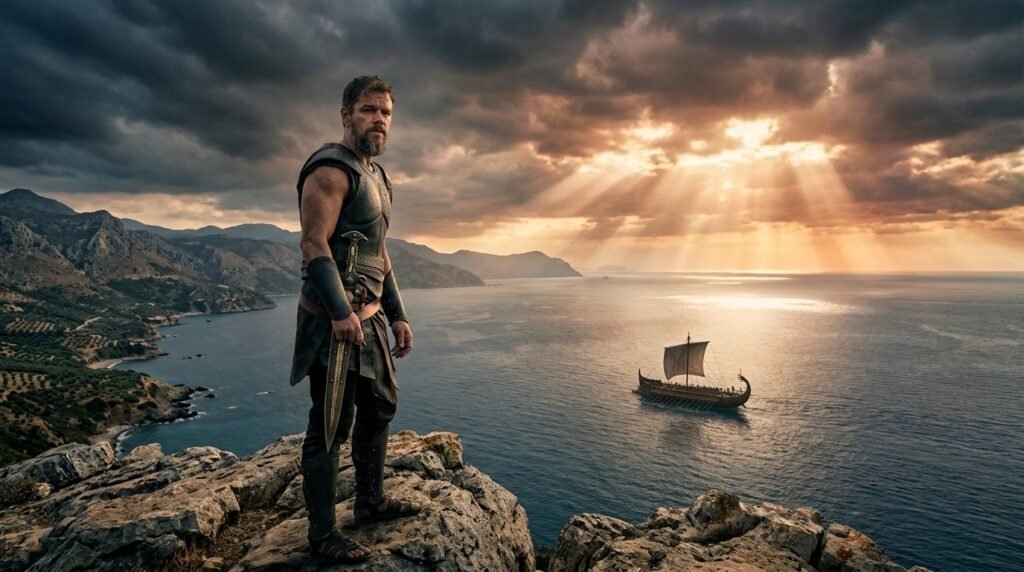
So, we need to talk about Christopher Nolan’s The Odyssey.
The epic adaptation of Homer’s legendary poem has finally arrived, and it is every bit as massive, strange, ambitious, and occasionally overwhelming as you’d expect from Nolan. With Matt Damon leading an enormous cast that includes Tom Holland, Anne Hathaway, Robert Pattinson, Zendaya, Charlize Theron, Lupita Nyong’o, and Samantha Morton, the movie takes one of the oldest stories in Western literature and turns it into a huge-scale cinematic experience.
It also gets surprisingly dark.
There are monster sequences that feel closer to horror than traditional mythology, a complicated timeline, a huge debate surrounding the costumes and historical accuracy, and some genuinely impressive filmmaking techniques behind the scenes.
Here’s everything you need to know about The Odyssey (2026), including the release date, cast, story, IMAX presentation, reviews, and the biggest controversies surrounding Nolan’s latest movie.
The Odyssey (2026) at a Glance
DetailInformation
Title The Odyssey
Director Christopher Nolan
Release Date July 17, 2026
Runtime 172 minutes
Main Star Matt Damon
Key Cast Tom Holland, Anne Hathaway, Robert Pattinson, Zendaya, Charlize Theron, Lupita Nyong’o, Samantha Morton
Source Material Homer’s Odyssey
Genre Epic, Adventure, Fantasy, Drama
Music Ludwig Göransson
Format IMAX and large-format theatrical presentations
Studio Universal Pictures
The Story Is More Complicated Than You Might Expect
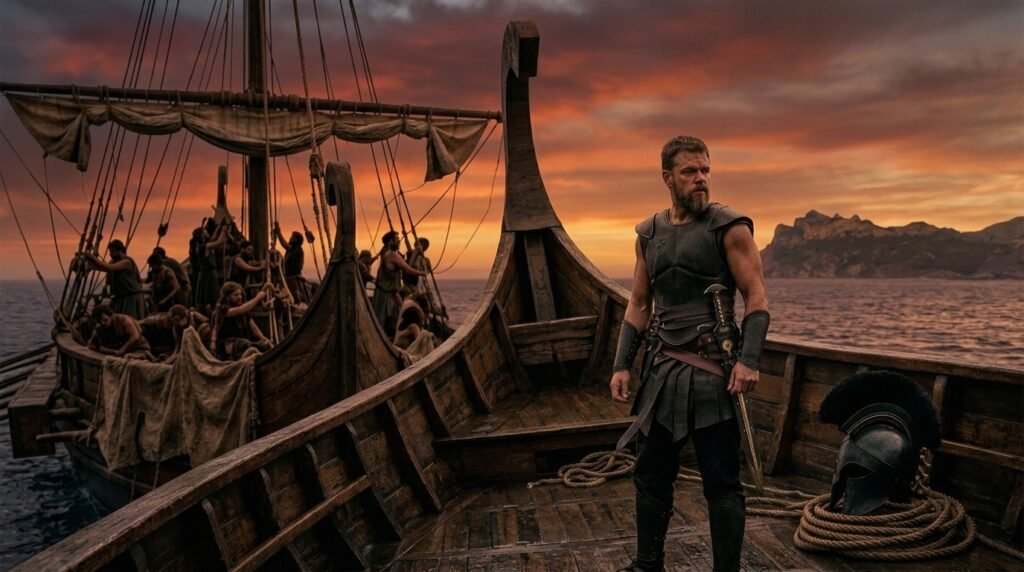
At its heart, The Odyssey follows Odysseus, played by Matt Damon, as he attempts to make his way home to Ithaca after the Trojan War.
That sounds simple enough.
It isn’t.
Rather than telling the story in a completely straightforward chronological order, Christopher Nolan plays with the timeline. The movie moves between Ithaca, Odysseus’s memories, the aftermath of the Trojan War, and the strange encounters that happen during his long journey home.
The story also spends significant time with Penelope, played by Anne Hathaway, and Telemachus, played by Tom Holland.
While Odysseus is missing, Penelope is surrounded by suitors who want to take his place, while Telemachus is trying to understand what happened to his father.
The result is a movie that is partly an adventure story, partly a psychological drama, and occasionally something that looks suspiciously like a horror movie.
The Timeline Is a Little Messy — But It Works
If you’ve watched Nolan movies before, you already know what you’re getting into.
The man does not particularly enjoy telling stories in the easiest possible order.
The Odyssey begins in Ithaca before moving through different periods of Odysseus’s journey and memories. The movie gradually fills in the missing pieces instead of simply showing everything from beginning to end.
The first 30 to 45 minutes can feel a little overloaded. There are a lot of characters, locations, relationships, and pieces of mythology to keep track of.
But once the different timelines begin connecting, the structure becomes much more rewarding.
It’s classic Nolan: make the audience work a little now and reward them later.
It’s Basically Oppenheimer With a Boat
Here’s one of the more interesting ways to look at The Odyssey.
In some respects, it feels like a mythological companion piece to Oppenheimer.
Both stories revolve around incredibly intelligent men who develop strategies capable of changing the course of a war.
Oppenheimer helps create the atomic bomb.
Odysseus develops the Trojan Horse strategy.
Both succeed.
And both have to live with the consequences.
Matt Damon doesn’t play Odysseus as a simple heroic warrior who is constantly celebrating his own cleverness. Instead, there’s a sense that this is a man carrying years of war and loss on his shoulders.
The Trojan War may be over, but psychologically, Odysseus is still fighting it.
That makes the character much more interesting than a traditional mythological hero.
Wait… Is The Odyssey Actually a Horror Movie?
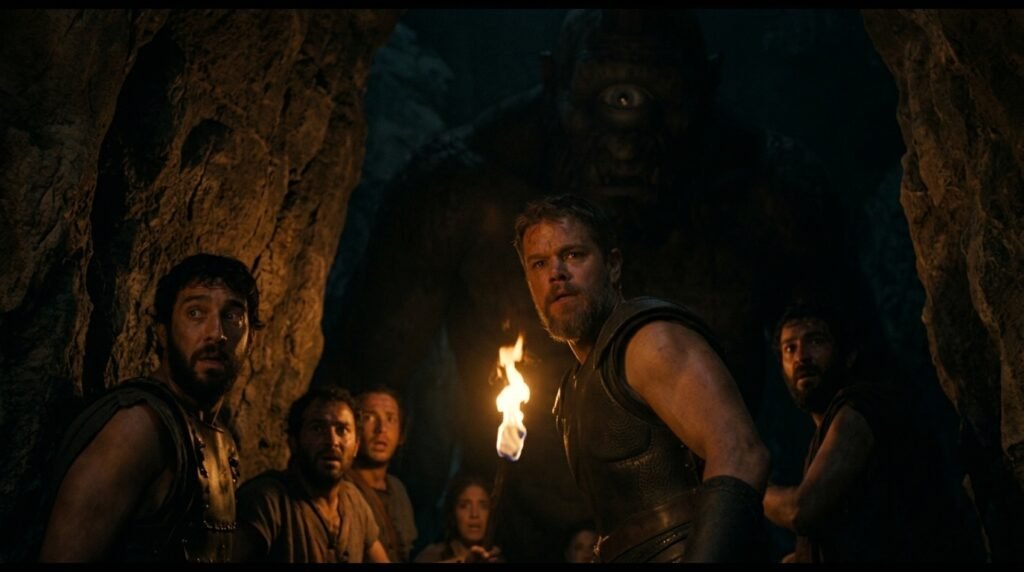
One of the biggest surprises is just how dark some sections of The Odyssey become.
The Cyclops sequence is probably the clearest example.
Instead of turning the creature into a brightly lit CGI spectacle, Nolan uses darkness and limited visibility to make the monster feel enormous and unpredictable.
You often don’t get a perfect look at what is happening.
And honestly, that makes it scarier.
The crew is trapped inside the Cyclops’s environment, and the sequence becomes less like a traditional fantasy adventure and more like a creature-feature horror movie.
Then there’s Circe’s island.
Samantha Morton’s Circe brings another unexpected horror element to the story, particularly during the transformation sequences involving Odysseus’s men.
The effects are designed to feel physical and uncomfortable rather than simply disappearing behind digital effects.
For a movie based on an ancient epic poem, some of these scenes are surprisingly nasty.
The Odyssey Cast: Who Plays Who?
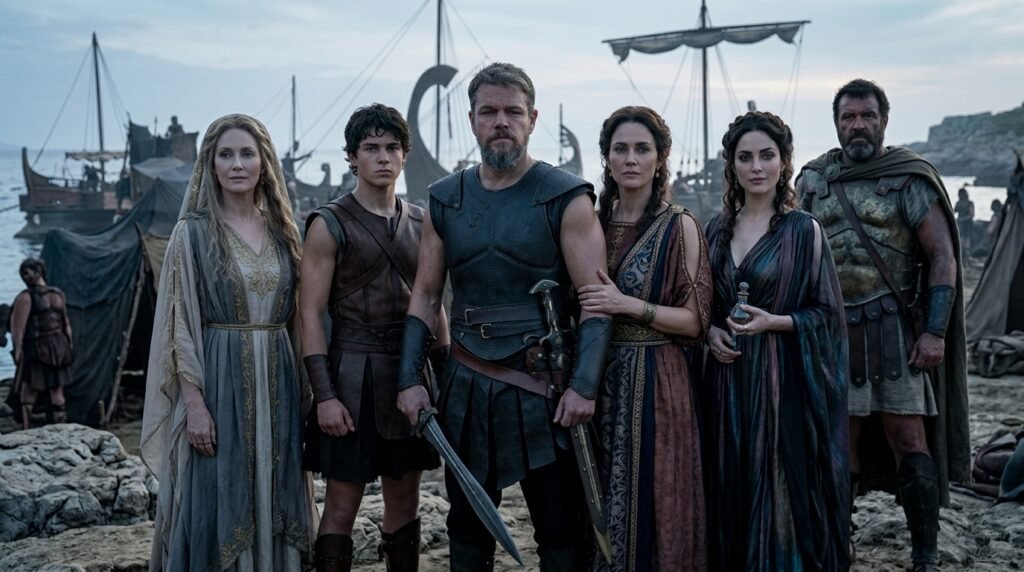
The cast is one of the movie’s biggest attractions.
Matt Damon as Odysseus
Damon takes on the central role of Odysseus, the legendary king of Ithaca attempting to return home after the Trojan War.
His version of the character is more psychologically damaged than the traditional heroic interpretation.
Anne Hathaway as Penelope
Anne Hathaway plays Penelope, Odysseus’s wife and one of the emotional anchors of the story.
While Odysseus is away, Penelope has to deal with the growing pressure from the suitors surrounding her.
Tom Holland as Telemachus
Tom Holland plays Telemachus, Odysseus and Penelope’s son.
His storyline focuses heavily on his search for information about his missing father and his attempt to understand the legacy of Odysseus.
Robert Pattinson as Antinous
Robert Pattinson plays Antinous, one of Penelope’s most aggressive suitors.
Pattinson brings a much darker energy to the character, making Antinous one of the movie’s more memorable antagonistic figures.
Zendaya as Athena
Zendaya appears as Athena, the goddess who plays an important role in Odysseus’s story.
Her presence also gives the movie another opportunity to explore the relationship between gods, humans, fate, and free will.
Charlize Theron as Calypso
Charlize Theron plays Calypso, the mysterious figure connected to one of the most important chapters of Odysseus’s journey.
Samantha Morton as Circe
Samantha Morton plays Circe, whose island provides one of the movie’s most unsettling sequences.
Lupita Nyong’o as Helen and Clytemnestra
Lupita Nyong’o takes on a dual role as Helen of Troy and Clytemnestra, giving the actress two very different characters within the mythology.
The Costume Controversy Explained
This is probably the part of The Odyssey that generated the most online arguments before and around the film’s release.
The costumes don’t always look like what audiences traditionally expect from a Bronze Age epic.
Some critics and classicists have argued that the armor and shields don’t accurately represent Bronze Age warfare. Comparisons with movies such as Troy (2004) have also become part of the discussion.
Agamemnon’s armor, in particular, became a major internet talking point, with some viewers jokingly calling the character “Batamemnon” because of the Batman-like appearance of the costume.
Costume designer Ellen Mirojnick has approached the movie as a cinematic interpretation rather than a strict archaeological reconstruction.
That’s an important distinction.
The Odyssey is inspired by an ancient poem, but Nolan isn’t making a documentary about Bronze Age Greece.
Whether you prefer the stylized approach or a more historically grounded look will probably come down to personal taste.
The Historical Accuracy Question
So, is The Odyssey historically accurate?
Not exactly.
And that’s not necessarily the point.
Homer’s Odyssey is a mythological epic containing gods, monsters, supernatural events, prophecies, magic, and legendary heroes.
Trying to recreate every element as though it were a modern historical documentary would be almost impossible.
Instead, Nolan’s movie appears to aim for a world that feels ancient while still functioning as a modern cinematic epic.
That approach has produced criticism from some classicists, particularly around armor, shields, costumes, and the visual interpretation of Bronze Age Greece.
For viewers who care primarily about the story and filmmaking, however, those choices may be less important than the atmosphere the movie creates.
The IMAX Technology Is Seriously Impressive
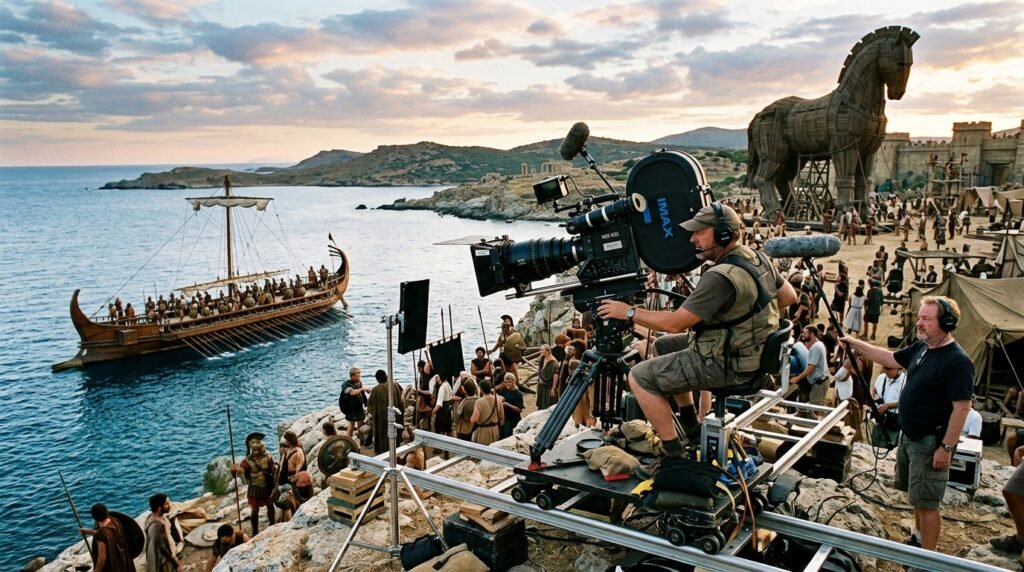
This is where Nolan does what Nolan does best.
The Odyssey was designed as a major large-format theatrical experience, with extensive use of IMAX filmmaking and practical production techniques.
The scale is immediately noticeable.
Instead of relying entirely on computer-generated environments, the production used real locations, practical sets, physical props, ships, and large-scale constructions to make the world feel tangible.
The goal is simple: when you’re watching Odysseus sail across the sea or stand inside an enormous ancient environment, you should feel like you’re actually there.
That approach becomes particularly effective in IMAX.
The larger format gives the landscapes, ships, battles, and practical sets considerably more visual impact.
If you’re planning to see The Odyssey in theaters, IMAX is arguably the way to experience the movie.
Ludwig Göransson’s Score Gives the Movie Its Sound
Another major part of the experience is the music.
Ludwig Göransson returns to collaborate with Nolan, creating a score that doesn’t simply sound like a traditional Hollywood historical epic.
Instead of relying exclusively on a huge modern orchestra, the soundtrack incorporates unusual textures and sounds inspired by ancient instruments and folk traditions.
Ancient Greek-style instruments, percussion, vocal elements, and atmospheric sounds help give the movie a strange, primal quality.
The result is a score that feels less like background music and more like another part of the world.
It helps make the supernatural sequences feel even more unsettling.
Does The Odyssey Live Up to the Hype?
That’s probably the biggest question.
The answer depends on what you’re expecting.
If you want a straightforward adaptation of Homer’s Odyssey, Nolan’s version may surprise you.
If you want a huge action spectacle with monsters, battles, gods, ships, and enormous IMAX images, there’s plenty here.
And if you’re interested in Nolan’s obsession with time, memory, guilt, and psychological consequences, the movie has plenty to unpack.
The biggest weakness is probably the complexity of the opening.
There is a lot of information to absorb, and some viewers may find the first part slower than expected.
But once the different pieces come together, the movie becomes much more compelling.
Will The Odyssey Be an Oscar Contender?
It’s difficult to imagine a Christopher Nolan epic of this scale not becoming part of the awards conversation.
The movie has several obvious categories where it could compete, including:
- Best Picture
- Best Director
- Best Adapted Screenplay
- Best Cinematography
- Best Production Design
- Best Costume Design
- Best Original Score
- Best Visual Effects
Matt Damon is also a potential Best Actor contender, while Anne Hathaway and Robert Pattinson could attract attention in the supporting categories.
The technical departments may ultimately be where The Odyssey has its strongest awards presence.
The IMAX cinematography, production design, costumes, sound, and Ludwig Göransson’s score all give the movie plenty of material for awards voters to consider.
The Odyssey vs. Oppenheimer
The comparison with Oppenheimer is inevitable.
Both movies come from Christopher Nolan.
Both focus heavily on the psychological consequences of extraordinary events.
Both use unconventional storytelling.
And both are built around men whose decisions affect thousands or millions of other people.
But the movies have very different scales.
Oppenheimer is grounded in twentieth-century history.
The Odyssey takes that psychological approach and throws it into an ancient world filled with gods, monsters, mythology, and supernatural forces.
In that sense, The Odyssey might be Nolan’s most ambitious attempt yet to combine blockbuster filmmaking with a deeply personal character study.
Frequently Asked Questions
When is The Odyssey 2026 release date?
The Odyssey was released in theaters on July 17, 2026.
Who is in The Odyssey 2026 cast?
The main cast includes Matt Damon, Tom Holland, Anne Hathaway, Robert Pattinson, Zendaya, Charlize Theron, Lupita Nyong’o, Samantha Morton, John Leguizamo, Jon Bernthal, and other major performers.
Who plays Odysseus in The Odyssey?
Matt Damon plays Odysseus, the king of Ithaca attempting to return home after the Trojan War.
Who plays Penelope in The Odyssey?
Anne Hathaway plays Penelope, Odysseus’s wife.
Who plays Telemachus?
Tom Holland plays Telemachus, the son of Odysseus and Penelope.
Who plays Antinous?
Robert Pattinson plays Antinous, one of Penelope’s suitors.
Who plays Athena?
Zendaya plays Athena.
Is The Odyssey historically accurate?
Not completely. The film takes creative liberties with costumes, armor, visual design, and the presentation of ancient Greece. Some classicists have criticized these choices.
How long is The Odyssey?
The movie runs for approximately 172 minutes, or around 2 hours and 52 minutes.
Is The Odyssey worth watching in IMAX?
If you enjoy large-format cinema, absolutely. Nolan designed the movie around large-scale imagery, practical production, and IMAX presentation, making a premium theater format particularly appealing.
Is The Odyssey based on a true story?
No. The Odyssey is based on Homer’s ancient epic poem, which combines mythology, legendary history, gods, monsters, and fictional storytelling.
Final Verdict
Christopher Nolan’s The Odyssey is not simply another Hollywood mythology movie.
It’s an enormous cinematic experiment that takes one of the oldest stories in Western literature and filters it through Nolan’s familiar obsessions: time, memory, guilt, trauma, identity, and the consequences of human decisions.
The movie isn’t perfect.
The opening can feel overloaded, the nonlinear structure may frustrate some viewers, and the costume choices have already created plenty of debate.
But when everything clicks, The Odyssey becomes something genuinely impressive.
The combination of Matt Damon’s haunted Odysseus, Nolan’s enormous practical filmmaking, the unsettling monster sequences, Ludwig Göransson’s unusual score, and the sheer scale of the IMAX presentation makes this one of the year’s biggest cinematic experiences.
Whether you see it as a faithful adaptation of Homer or as Christopher Nolan’s personal interpretation of the myth, one thing is difficult to deny: